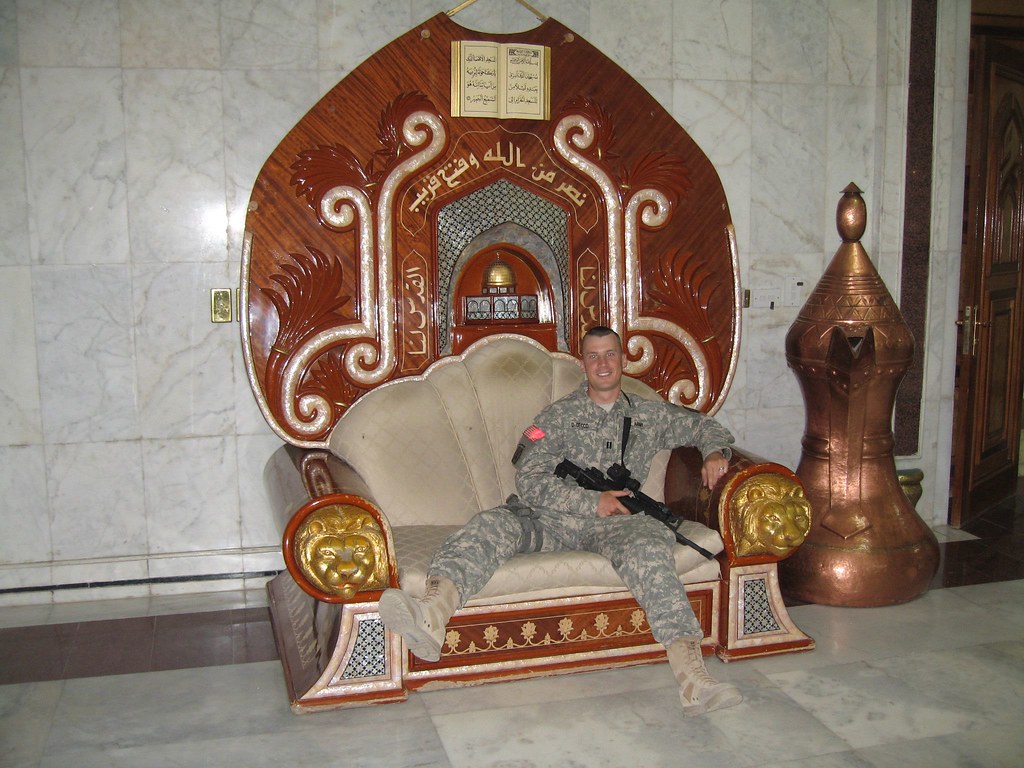
I've been avoiding my blog lately. Ahh, it feels good to admit it. I think part of the reason I was avoiding it is because that writing again would mean that yes, I am really back here in Iraq. This isn't a bad dream I'm having, and Chester isn't going to wake me up by licking my face. It took me a couple weeks to really come back into the mind-set that I need to be in, but, here I am!
This is going to come as a huge surprise to most people, so brace yourselves - but since I left, there has been almost NO change in any of the projects going on here. Shocker, I know. It's not my absence that fueled the complete and utter lack of progress, because let's be honest - there wasn't any forward progress when I was here! I guess I harbored some deep hope of returning to a plethora of construction projects underway, some nearing completion and others just beginning, and then I could hold hands with the Iraqi's and sing Koombya and we'd all be happy. Instead, the same set of warehouses being worked on when I left is still being worked on, and the two scheduled to begin, haven't yet begun. The Iraqi's aren't really to blame here, though. What's holding us back? We have the money allocated, we have the design plans approved, and we have bidders. Mostly what is holding us back is good old American bureaucracy. Paperwork. Miscommunication. Things that make me slap my forehead repeatedly like Homer Simpson with a big "D'Oh!"
One good sign is that we are starting the process for end-of-tour awards and evaluations. Yes, this is a process that will take up to 4 months, but just starting it at least signals the beginning of the end. Not that I am looking forward to going home or anything. I've already informed my chain of command that the only award I want is a DD214 (which is the document you get when you are discharged from the Army). They half believe me. I think there should be an IRR award. I continue to get reports from friends going through the process now who tell me about a 33% or less show rate for IRR recalls. I know we signed a contract and are obligated to report, but most of us who showed up when we got the call did so more as a sense of duty. As much as we deny that in our current state of bitterness, it was more of a moral obligation than anything. What happens to the 67% that don't show up? Nothing. Seriously. I have all but confirmed that there are more no shows than the Army can handle and so nothing of any consequence happens to those who don't report. Do I wish I didn't report? No. I am too much of moral nerd to have lived with myself for not showing. So here I am, again. It's almost over now anyway, so I better stop writing and start making an impact on this country. What - me, sarcastic? Never!
For slightly a slightly less sarcastic view of a current event in Iraq, read this post by Brendan B.
Tuesday, December 11, 2007
reality check


Wednesday, August 22, 2007
More, Please
I'm starting to notice that my time in between posts is slowly drifting apart. This isn't intentional; I have just been extremely frustrated and I am trying to take a step back before blasting my frustration into the blog and turning it into a wordy bitch session. That being said, I need to write about a conversation I had with my Iraqi counterpart this past morning.
It was a dusty morning, already approaching 95 degrees at about 8:45am. We were driving through the depot, talking about how to better organize certain warehouses and what work needed to get done. The conversation then turned to physical improvements that needed to be done, and I got excited because this is an area I have been working since we arrived here. We have already rebuilt the guard houses that used to be falling apart, impressed with them; he stated that the warehouses needed to be fixed in a similar fashion. I happily responded that we have already contracted out the work, which would begin soon, and that they would be as good or better. He then declared that we need power; I again responded excitedly that we have plans to run power all throughout the depot, including street lamps and power to all the warehouses. In addition, I continued, we are going to have the roads repaired and the spaces in between each warehouse graded and leveled for drainage. On top of all that, we have another project for a central receiving and shipping point which will include new offices and a consolidated operations center.
I'm not sure what kind of reaction I was expecting, but I do know I wasn’t expecting what followed.
"What about water", he asked through the interpreter.
I was confused, and asked "Water? What do you mean? Drainage?"
"No", he replied. "Water from pipes. To all the warehouses."
I was stunned. "No, there are no plans to run water mains to all of the warehouses, sir. We've spent close to $100 million on the improvements I just talked about, and if we wanted to run water mains it would easily be double that. There just isn't enough money."
He looked disappointed, and replied simply "Well, we need it. We should have water mains here."
I was still bewildered by this request. "Sir, I've been over this with your boss. We talked about all of the improvements we'd need to make in order to run this depot more efficiently. Water mains are a luxury, and are so expensive that their cost cant possibly be justified."
He just shook his head, clearly not happy and disappointed. At this point I was starting to get angry, so I simply looked at my interpreter, shook my head and said nothing. I thought angrily to myself, Water mains? Is he kidding me?? Everywhere I have ever been, to include the US, we use bottled water. We provide them unlimited bottled water here. There is no need to wash in the warehouses since the living quarters are located somewhere else. I couldn't stop thinking about this verbal exchange all day. This wasn't the first time I've received feedback like this. Here we are in Iraq, pouring 100s of millions of US dollars into their military, their government, and their infrastructure; and yet, the only response I get from many when we describe our improvement projects is almost disappointment that we aren't doing MORE. It is the same with our role as advisors. We are constantly being asked to do MORE, to provide MORE fuel, MORE new equipment whenever theirs breaks, MORE work out of our own Soldiers.
This is what frustrates me, because I still feel like the more we give, the more they expect and the more they want. What I need to do is try and understand things from their perspective more. For example, water is a big deal to the Iraqi's. They grew up without having much water in their homes and learned from an early age to hoard it and store it whenever its available. Of course my counterpart is going to request it when he hears how much money we are spending on other things. That being said, they also need to understand what's important and what is nice to have. I still feel like we are failing in conveying mission criticality to them; too often we are scrambling to get things done and they are standing by watching. How do we solve this? How do we change our perspective to understand them better and not get so frustrated by their constant clamoring for more? We could leave, but I still don't think that’s the right answer (Actually we can’t leave, but you know what I mean). Problem is, I don't know what the right answer is, and I don't think anyone else does, either.
Friday, August 10, 2007
The reoccurring question
The sweat rolling down my back had turned from a leaky faucet to the Tigris River by mile 1. It was 122 degrees out and I couldn’t help but think that I was wearing an oven as opposed to body armor. As the sand blew into my face and the hotspots on my feet grew into raging inferno's, I again asked myself, "What the hell am I doing here?"
The past couple weeks have been interesting. Not really a good interesting, although we did have our moments of laughing at the absurdity of our situation. No, it was interesting because I think I can now write a book on poor leadership and failed execution, from the top of the chain straight through to us.
It began on a Thursday night, when my favorite senior advisor came knocking on my door at 10pm demanding that I write a justification for why we need vehicles, phones, and computers. Not liking the dumbfounded smirk that overtook my face, he snapped and mumbled something to me that I am sure would have pissed me off had I been paying attention. I, however, was too lost in my own thoughts, which were screaming at me to make a smart-ass remark like "No problem, Sir! I'll get the justification for why we need oxygen to you right after that!"
It wasn't a hard document to write; we are the main logistics hub of the Iraqi Army, so without simple communications like computers and phones we would be almost completely ineffective. Vehicles are needed in part because we have live 3.5 miles from the depot, and in part because the depot itself is over 5 sq. miles. Without vehicles we would have to walk to each of our 70+ warehouses, which would take an unnecessary amount of time and be really inefficient. So I wrote the justification, and the next morning we lost everything.
There are alot of things that need to be explained here. I'll start with how and why we lost all of our stuff. Apparently, a general from cubicle-land (i.e. the IZ) ordered that all outposts where Americans were advising Iraqi's must turn in their vehicles and equipment to the Iraqi Army. This order sat in limbo for a couple of weeks and then all of the sudden people starting saying, crap - he's serious. Our leader's crap he's serious moment apparently came at 10pm on Thursday night when he asked for the justification. I can tell you from past experience that trying to justify something the night before is usually a bad idea. As it turned out, this experience held true.
I can understand why the general wanted this. Since we are embedded with the Iraqi's we are forced to use much of their equipment to help them do their mission. Problem is, we are doing most of their mission. So by turning everything back in and leaving us helpless, we more or less leave the Iraqi's to do their own mission. Here's the problem with that, though: All of our orders come from the American Headquarters! So, in order for the Iraqi's to do their own work, they'd have to be able to coordinate with the American HQ element, which, of course, they can’t do. So for 5 days, we walked to work, advised the Iraqi's on what we thought needed to be done, and the walked home. It was almost impossible to get anything done since we essentially blacked out from communications, and therefore had no access to real-time logistical requirements. I didnt really mind the walking part; there are thousands of other troops here who have to do alot of walking in alot more dangerous situations, so if this is as bad it gets for me I am a very lucky man (although those of you who know me also know that I am dying inside here and would give my left nut to be on the streets!)
After 5 days of absolute mission failure, our command decided that we needed at least basic access to phones and computers. Brilliant! They also gave us American-bought vehicles for transportation, although I am still walking occasionally. I like walking with my Soldiers - it's sucks, so its bonding time. There is alot of work to be done now, since we fell way behind during those 5 days. There is also talk of us moving from an advisor role to full time operations, since the Iraqi logistics system is still perceived to be broke. However, I still struggle to understand how we can advise them when we operate under an American command. No progress is going to be made until the American staff starts advising the Iraqi staff, and logistics are coordinated by the Iraqi's, not the Americans. It's odd how no one seems to realize this. It will also be extremely disheartening if we have to take over daily operations. This will set us back at least a year and will throw out almost all of the trust we’ve built with our counterparts. I do agree that things here need to be done differently, but much of that has to do with leadership (both sides). The Iraqi leadership is, well . . .shady, to put it nicely. In any event, I hope someone up higher soon realizes this and doesn’t set us back in our advisory roles.
I hope to update again soon and post new pics, especially since its been about two weeks since my last post. Until then, I am going to practice biting my tongue a little more!
Friday, January 26, 2007
New friends
There are things I really missed about the military. One of the biggest things is the camaraderie that you tend to develop with your co-workers. This proved to be true again at Fort Jackson. In just a short time, a group of about 14 of us became fairly close friends. We are all captains, and we all got out for different reasons. We were from different branches - Logistics, Communications, Infantry, and Armor. Yet, we all ate together everyday; we hung out together at night, and when we had a free night, we went into town and had a good meal and some drinks. After a week, it seemed as if we all were old friends. The hardest part about going to Fort Lee was leaving these guys and girls. Luckily, 6 of us were going to Fort Lee together. Two more will go to separate places and re-join us at Fort Riley, where we are supposedly meeting up with the unit we will go to war with. Not so luckily, the others are going to completely different places, probably ending up in Afghanistan. We exchanged emails and phone numbers, and have kept good contact so far, but we all know it will never be the same. There are bonds formed between people who go through similarly tough situations, and everyone can relate somehow. The bonds you form with your teammates during pre-season conditioning; the bonds you form with co-workers on tough road trips; the bond you feel with your family after someone close to you dies. We all know that the bond will always remain, but it’s never the same as when you are toughing it out together. As a good friend likes to say, such is life.