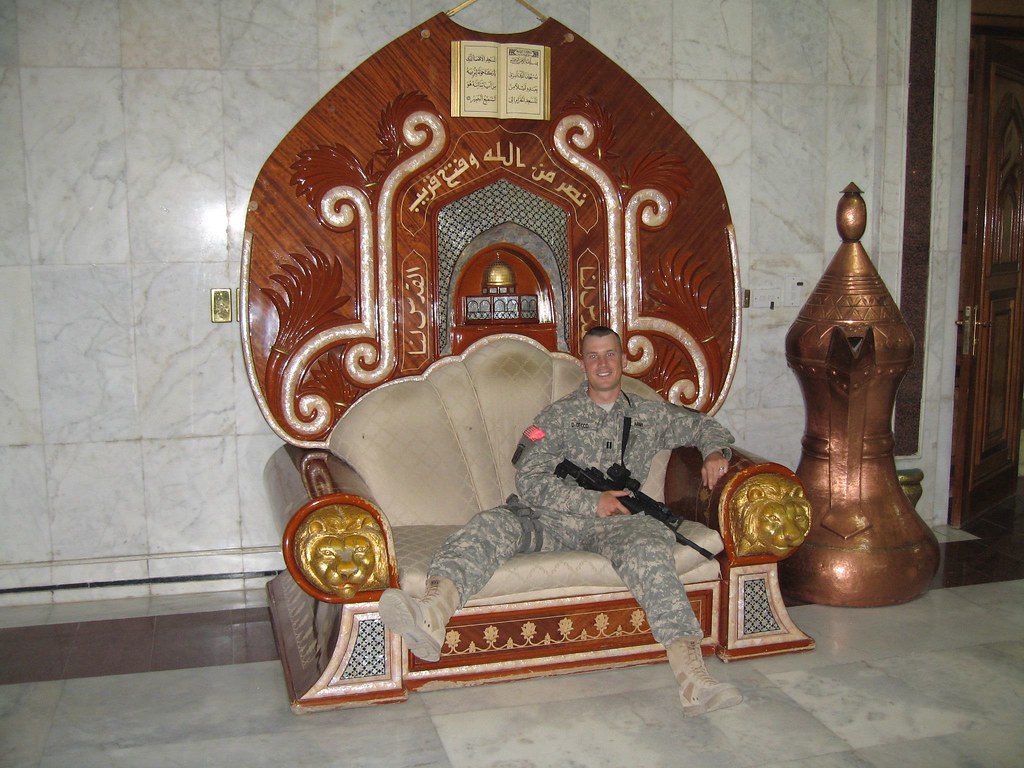
I'm starting to notice that my time in between posts is slowly drifting apart. This isn't intentional; I have just been extremely frustrated and I am trying to take a step back before blasting my frustration into the blog and turning it into a wordy bitch session. That being said, I need to write about a conversation I had with my Iraqi counterpart this past morning.
It was a dusty morning, already approaching 95 degrees at about 8:45am. We were driving through the depot, talking about how to better organize certain warehouses and what work needed to get done. The conversation then turned to physical improvements that needed to be done, and I got excited because this is an area I have been working since we arrived here. We have already rebuilt the guard houses that used to be falling apart, impressed with them; he stated that the warehouses needed to be fixed in a similar fashion. I happily responded that we have already contracted out the work, which would begin soon, and that they would be as good or better. He then declared that we need power; I again responded excitedly that we have plans to run power all throughout the depot, including street lamps and power to all the warehouses. In addition, I continued, we are going to have the roads repaired and the spaces in between each warehouse graded and leveled for drainage. On top of all that, we have another project for a central receiving and shipping point which will include new offices and a consolidated operations center.
I'm not sure what kind of reaction I was expecting, but I do know I wasn’t expecting what followed.
"What about water", he asked through the interpreter.
I was confused, and asked "Water? What do you mean? Drainage?"
"No", he replied. "Water from pipes. To all the warehouses."
I was stunned. "No, there are no plans to run water mains to all of the warehouses, sir. We've spent close to $100 million on the improvements I just talked about, and if we wanted to run water mains it would easily be double that. There just isn't enough money."
He looked disappointed, and replied simply "Well, we need it. We should have water mains here."
I was still bewildered by this request. "Sir, I've been over this with your boss. We talked about all of the improvements we'd need to make in order to run this depot more efficiently. Water mains are a luxury, and are so expensive that their cost cant possibly be justified."
He just shook his head, clearly not happy and disappointed. At this point I was starting to get angry, so I simply looked at my interpreter, shook my head and said nothing. I thought angrily to myself, Water mains? Is he kidding me?? Everywhere I have ever been, to include the US, we use bottled water. We provide them unlimited bottled water here. There is no need to wash in the warehouses since the living quarters are located somewhere else. I couldn't stop thinking about this verbal exchange all day. This wasn't the first time I've received feedback like this. Here we are in Iraq, pouring 100s of millions of US dollars into their military, their government, and their infrastructure; and yet, the only response I get from many when we describe our improvement projects is almost disappointment that we aren't doing MORE. It is the same with our role as advisors. We are constantly being asked to do MORE, to provide MORE fuel, MORE new equipment whenever theirs breaks, MORE work out of our own Soldiers.
This is what frustrates me, because I still feel like the more we give, the more they expect and the more they want. What I need to do is try and understand things from their perspective more. For example, water is a big deal to the Iraqi's. They grew up without having much water in their homes and learned from an early age to hoard it and store it whenever its available. Of course my counterpart is going to request it when he hears how much money we are spending on other things. That being said, they also need to understand what's important and what is nice to have. I still feel like we are failing in conveying mission criticality to them; too often we are scrambling to get things done and they are standing by watching. How do we solve this? How do we change our perspective to understand them better and not get so frustrated by their constant clamoring for more? We could leave, but I still don't think that’s the right answer (Actually we can’t leave, but you know what I mean). Problem is, I don't know what the right answer is, and I don't think anyone else does, either.
Wednesday, August 22, 2007
More, Please


Saturday, August 11, 2007
The Ligers
No, the title is not referring to my uncle's fantasy football team that won the league championship last year (although they did). The Ligers are what we nicknamed ourselves after a surprise visit from a 10-person "Tiger" team sent by our higher HQ. What's a Tiger team? Great question, and it’s the same question we asked upon their arrival. The answer we received is that a Tiger Team is an ad-hoc team sent to fix problems where the current personnel are unable to do so themselves. Ohhh - so basically a group of our peers who have been working in an office for the last 3 months are sent to the field to fix problems they really don’t know much about. As you can tell, their arrival didn’t sit well with us, and so we called ourselves the Ligers, because a Liger will always beat a Tiger.
In actuality, neither group started off on the right foot, and to be fair to that group, we didn’t give them much of a chance. One of my good friends from 10th Mountain was one of the individuals on the team, but I didn't give her much preferential treatment (sorry!). It's hard for us to accept that after 3 months of living and working with the Iraqi's, a team of staff officers is going to come tell us how to solve all our problems. We've suffered through broken equipment, long periods of no power, lack of fuel, and countless other circumstances that have given us a bond with our Iraqi counterparts. We are just starting to really see how things work, and now we are being told everything is broke, falling apart at the seams and it’s more or less all our fault. So yea, we got pretty defensive.
During a negotiation I had with one of the team members, a light switch went off somewhere in my head. We were discussing fuel, and how they (the coalition) were going to put in a request to get us (the Iraqi unit) as much fuel as we ever needed. Well, this pissed me off. For the past 3 months we have been forcing the Iraqi's to manage their fuel situation on their own - and when they run out, there is no safety net from the coalition. Our experience with them has shown us that when we provide the safety net, they don't work as hard to manage their own situation. Why would they, when we'll just bail them out if they fail? Our negotiation hit a tense point, and the conversation then went like this:
After explaining the reason we didn't like to give them coalition fuel, I was asked, "So are you prepared to answer for failed missions and explain that you refused fuel?"
"Damn right I am", I snapped back. "You know what? That’s the problem here. We have a coalition-run HQ coordinating and commanding logistics down to Iraqi-run ground units. How can we make any progress that way??" At this point I barely paused to catch my breath, and the veins in the side of my head were beginning to pulse.
I continued on, "It's like this: If we fail to make a mission here, our coalition HQ comes down on the coalition advisor's here. Who, then, is coming down on the Iraqi's? That's supposed to be our job in a way, but do you really thing the Iraqi's are paying much heed when they know we'll be gone in 8 months?"
No response, so I drove forward. "What needs to happen is our HQ needs to put aside their arrogance and start letting the Iraqi's command the Iraqi's. Then, when a mission fails, have an Iraqi general come down hard on the Iraqi commanders here. These guys are lifers - you better believe they care when their commanding officers bring a shit storm down on them!"
"There's a difference between letting them fail, and letting them fail miserably. We can’t let them fail miserably", she finally replied in a tone to match mine.
"The hell we can’t!” I replied. "How are they ever going to learn otherwise?"
At this, the negotiations pretty much broke up; the other participants were beginning to stare and my voice was getting elevated. Thinking back on the conversation, though, neither of us was really right or wrong. She was absolutely correct in assuming we need fuel, and was simply trying to help me by providing a solution. As I tend to do, I over analyzed the situation and took some pent up feelings out on her. Here's the important part to me, though - there is a disconnect. The coalition wants mission accomplishment first and always, and are willing to throw resources to the Iraqi's to ensure that happens. However, as long as we continue to provide them with unending resources and safety nets, they'll never start depending on themselves to do it.
Where do we draw the line though? Fact is, there are American troops with each Iraqi unit, and if that Iraqi unit doesn't get what it needs, we hurt Americans. That fact is what drives us to continually bail out the Iraqis - we can’t, and won’t, let a mission fail when American lives are at stake. It’s also for this reason I have to somewhat concede the above argument. I obviously don't have all the answers, but I am pretty adept at identifying problems and putting together working solutions. I finally pinpointed our problem here, what I'll dub as the great disconnect, and I feel helpless to correct it.
That being said, we have a whole of working solutions in place. Everything from increased manpower (we are at about 35% strength on the Iraqi side), to longer working hours, to complete refurbishments of the crumbling warehouses. A year from now, this place WILL be better then when we arrived. The question is, will it be good enough?
Friday, August 10, 2007
The reoccurring question
The sweat rolling down my back had turned from a leaky faucet to the Tigris River by mile 1. It was 122 degrees out and I couldn’t help but think that I was wearing an oven as opposed to body armor. As the sand blew into my face and the hotspots on my feet grew into raging inferno's, I again asked myself, "What the hell am I doing here?"
The past couple weeks have been interesting. Not really a good interesting, although we did have our moments of laughing at the absurdity of our situation. No, it was interesting because I think I can now write a book on poor leadership and failed execution, from the top of the chain straight through to us.
It began on a Thursday night, when my favorite senior advisor came knocking on my door at 10pm demanding that I write a justification for why we need vehicles, phones, and computers. Not liking the dumbfounded smirk that overtook my face, he snapped and mumbled something to me that I am sure would have pissed me off had I been paying attention. I, however, was too lost in my own thoughts, which were screaming at me to make a smart-ass remark like "No problem, Sir! I'll get the justification for why we need oxygen to you right after that!"
It wasn't a hard document to write; we are the main logistics hub of the Iraqi Army, so without simple communications like computers and phones we would be almost completely ineffective. Vehicles are needed in part because we have live 3.5 miles from the depot, and in part because the depot itself is over 5 sq. miles. Without vehicles we would have to walk to each of our 70+ warehouses, which would take an unnecessary amount of time and be really inefficient. So I wrote the justification, and the next morning we lost everything.
There are alot of things that need to be explained here. I'll start with how and why we lost all of our stuff. Apparently, a general from cubicle-land (i.e. the IZ) ordered that all outposts where Americans were advising Iraqi's must turn in their vehicles and equipment to the Iraqi Army. This order sat in limbo for a couple of weeks and then all of the sudden people starting saying, crap - he's serious. Our leader's crap he's serious moment apparently came at 10pm on Thursday night when he asked for the justification. I can tell you from past experience that trying to justify something the night before is usually a bad idea. As it turned out, this experience held true.
I can understand why the general wanted this. Since we are embedded with the Iraqi's we are forced to use much of their equipment to help them do their mission. Problem is, we are doing most of their mission. So by turning everything back in and leaving us helpless, we more or less leave the Iraqi's to do their own mission. Here's the problem with that, though: All of our orders come from the American Headquarters! So, in order for the Iraqi's to do their own work, they'd have to be able to coordinate with the American HQ element, which, of course, they can’t do. So for 5 days, we walked to work, advised the Iraqi's on what we thought needed to be done, and the walked home. It was almost impossible to get anything done since we essentially blacked out from communications, and therefore had no access to real-time logistical requirements. I didnt really mind the walking part; there are thousands of other troops here who have to do alot of walking in alot more dangerous situations, so if this is as bad it gets for me I am a very lucky man (although those of you who know me also know that I am dying inside here and would give my left nut to be on the streets!)
After 5 days of absolute mission failure, our command decided that we needed at least basic access to phones and computers. Brilliant! They also gave us American-bought vehicles for transportation, although I am still walking occasionally. I like walking with my Soldiers - it's sucks, so its bonding time. There is alot of work to be done now, since we fell way behind during those 5 days. There is also talk of us moving from an advisor role to full time operations, since the Iraqi logistics system is still perceived to be broke. However, I still struggle to understand how we can advise them when we operate under an American command. No progress is going to be made until the American staff starts advising the Iraqi staff, and logistics are coordinated by the Iraqi's, not the Americans. It's odd how no one seems to realize this. It will also be extremely disheartening if we have to take over daily operations. This will set us back at least a year and will throw out almost all of the trust we’ve built with our counterparts. I do agree that things here need to be done differently, but much of that has to do with leadership (both sides). The Iraqi leadership is, well . . .shady, to put it nicely. In any event, I hope someone up higher soon realizes this and doesn’t set us back in our advisory roles.
I hope to update again soon and post new pics, especially since its been about two weeks since my last post. Until then, I am going to practice biting my tongue a little more!
Friday, July 27, 2007
Football
As the temperature climbs above 120 and the days seem to get longer and more frustrating, I can’t help but find myself looking forward to the start of training camp for the Philadelphia Eagles. There are a hundred other things I worry about on a daily basis, all admittedly more important, yet I can’t help from fantasizing about Brian Westbrook reaching 1,000 yards rushing this season and the Eagles playoff possibilities. I keep telling myself - once football season is here, this deployment will fly by. Since we get a handful of selected programs broadcast here via the Armed Forces Network, I will most surely get to see at least one football game per week, which will be something nice to look forward to.
My excitement for football season, however, pales in contrast to the excitement I see over here for the Iraqi National Soccer team. This is no joke - things basically shut down when the games are on so the Iraqi Soldiers can watch it on TV. On Wednesday, when the Iraqi team played the South Koreans, I needed one of the Iraqi Soldiers to load up a truck to prepare for the next day's shipment. We gave him instructions on what needed to be done, but when I saw his facial expression I stopped to think for a minute. Here was one of the better soldiers we had; dependable, reliable, hardly complains, willing to get the mission done. Although he was trying to hide his disappointment, when we asked him to do this job he readily agreed. His smile, though, betrayed him. Through his smile I could see clenched teeth; his eyes were squinted and his jawline taught. It was the smile of a proud man who just saw his dog get put to rest and he doesn't want to cry in front of anyone. (yes, dad, he looked strangely similar to a face I've seen you make!) So after he walked out the door to get started I ran after him and asked if he could get it done tomorrow morning, instead. I know this puts me at least 2 weeks back in getting them to do things today, not tomorrow, but sometimes you have to give a little to get a little. The expression on his face was worth it, too - relieved joy and a genuine smile. The he took off at a full sprint to watch the rest of the game.
The Iraqi's won, by the way. One habit that we had to mitigate for this game was the celebratory fire - luckily, they listened, because they realize we have guns too and might mistake their celebration for an attack. The article I linked to makes a great point about a united Iraq on the field and divided off the field. It may be a bit dramatic, but its journalism so it needs to be. I do agree with it, however. If there is one thing the Iraqi people can and will unite together for, its soccer. They play here everyday, and they play in the leagues sponsored by the coalition side of base. We escort the team of 12 over to play, and then escort the team of 200 Soldiers over to cheer on their team. There is not a single team that plays in these little tournaments that has the cheering section like our Iraqi's do.
So now this Sunday I have a different type of football game to look forward too. Iraq plays Saudi Arabia in the championship game, and the buzz around here is tremendous. It feels like being back in Philadelphia before the NFC Championship game - excitement, optimism, and brotherly love abound. Not exactly the emotions we encounter on a daily basis, yet a soccer team has brought them out. So there is some dramatic journalism from me; but sports, especially football, seem to bring that out in me. Except it looks like it's not just me that football has that kind of impact on . . .
Saturday, July 21, 2007
Summertime Blues
BOOM!-thud-
ughhh . . . I groan and roll over to look at my clock.
BOOM!-thud-
It's 3:15am, and the Artillery detachment is sending out some care packages to our boys outside the wire. No surprise there; the artillery men send out their lovin' every night, and since we are almost right next to them I get to hear every round up close and personal. The only question is what time and how often. The nightly barrage goes on...
-thud- BOOOM!!
I couldn't tell if I was dreaming or I heard rocks being thrown at my wall. I wipe the haze from eyes and check my clock - 1 something AM. I sit up to drink some water and then I hear something I wasn’t expecting:
WAHHHH "INCOMING! INCOMING! INCOMING! All personnel take cover!" WAHHHH! "INCOMING! INCOMING! INCOMING!"
ughh. . .why are you yelling at me to take cover after the fact? I wonder to no one in particular. I step outside (probably not what I am supposed to do) to a hazy, smoke filled night. The moon is slightly orange and is casting an eerie glow over the gravel lot outside my building. Someone else is up too.
"Hey, glad the Big Voice told us to take cover 30 seconds AFTER the fact", Nap calls to me.
"Ha - yea - good thing", I reply before I make a quick stop in the porta-pottie and go back to sleep minutes later.
These are a couple typical nights for us here. Nothing exciting, just the sounds of the battle going on around us. Our job isn't out there at night; it begins the next day with our Iraqi counterparts. Everyday we work with them, side by side, imparting what knowledge we have and trying to help them do their part better. Many nights I wish I was out there with my coalition counterparts, fighting a battle I know a little better; but I'm not, and many days it’s hard for me to accept that my battle is in getting the Iraqi's to sustain themselves without our help.
The other night my LT buddy and I were sitting outside, watching the Apache's fly overhead and listening to the artillery go out (at least, we always say its outgoing). We started talking about how far from home we are and what we're doing here. (I am 6,300+ miles from home, by the way). The conversation started off almost philosophically:
"Dude, do you know how far from home we are?” he asked me.
"6,322 miles", I replied.
"Yea, that’s far. What the hell are we doing here? Do you know how hard it would be for us to get home if there were no planes?"
I paused. "Probably close to a year. We'd most likely have to hump it up to the Mediterranean Sea, catch a freighter, and then sail the Oceans home."
He sighed deeply. "Yea. That would suck. Can you imagine being a roman back in the day? Or trying to get back to America at that time?"
"Yea, but if we were trying to get back to America then, we'd most likely be American Indians and we'd have no business here in the 1st place."
"True enough", he answered, and there ended our deep philosophical discussion.
After we pondered that for a minute, we started talking about whether what we're doing will have any benefit to us in the civilian world once we're done. I wished I could have answered him positively, but I just couldn't, really. He is a Construction Engineer, and I am a Chemical Engineer. We're both advising the Iraqi Army on logistics. We tried to find some benefits; he is heading up a major project to issue the entire Iraqi Army M-16s, and I am handling contracts totaling 100s of millions of US dollars. Still, it’s hard to say how that will help us advance to the next level in our civilian jobs. I personally feel like I've taken at least a two year step backward; the promotion I worked two years for was rescinded because I couldn't fill it due to my recall, and I was just notified recently that our plant is undergoing major layoffs. The layoffs shouldn't affect my job, since I am on military status, but I know it will probably take at least a year to get back to where I was before I left. That's not even getting into how people will feel that I still have a job because I was on military status. I know, and most people wont come out and say that, but realistically, deep down, some will be thinking it.
We ended the conversation on a positive, though. We are here doing what not many other people get an opportunity to do. We're basically helping to build an Army from the ground up and learning alot about ourselves and others in the process. Heck, if we ever go into consulting we will honestly be able to say that we have done consulting work under the harshest conditions and across seemingly insurmountable cultural differences. So we ended by saying that we were underglorified, underpaid consultants, and that if all else goes to crap, at least we have that. Yea . . . Sure . . .
Tuesday, July 10, 2007
The Onion
The honeymoon phase is over. We are slowly realizing that this place is sort of like an onion - everytime we peel away one layer, we discover another layer underneath - and they all make us want to cry. For example, a few posts ago I wrote about my frustration with the Iraqi major who insists on turning away all of the supplies before they even enter our compound. I couldn't figure out why he was so stringent on the quality of products, and it was driving me crazy. He was turning away perfectly good supplies for no reason! One day I'd finally had enough. In the 115 degree heat, we spent 45 minutes climbing in and out of trucks looking at what we were about to receive. Everything looked good to me, no different then what we'd get on the coalition side of base. The Iraqi's, however, didn't think so, and tried to turn the trucks away. After a heated argument, I made them allow the trucks in because I wasn't going to be responsible for jeopardizing the drivers’ safety. Seeing my frustration, one Iraqi that I trust pulled me aside and gave me some inside info, which was later verified through another source who came to me in confidence. Apparently, there are some Iraqi's here who demand bribes from the drivers in order to let them into our compound to deliver their supplies. Most drivers pay, because if they are turned away they face the repercussion of not being paid by their employer, with the added danger of having to drive the dangerous roads. So, now I have to figure out how to stop this. It seems to be a directive from some of the top officers, which makes changing the procedure difficult. Some people think it’s just a cultural thing and there is nothing we can do to stop it. Great attitude! Let’s promote corruption by taking the attitude that if we can’t stop it, ignore it! Well, I refuse to accept this and am currently looking for ways to catch them in the act. Easier said then done, though.
To further improve my morale, I learned the reason I was called up was due to gross personnel mismanagement by the reserve unit I am attached to. Here's the story, confirmed by the unit: When notified to deploy, the 104th scoured their list of qualified candidates and cross leveled and determined that they didn't have enough Captains to fill mission requirements. They put a request into Human resource Command (HRC), who proceeded to fill the unit needs by recalling the requested officers from the Inactive Ready Reserve. The rest is obviously history - I got my telegram and reported as ordered and here I am. Here's the catch, though. After receiving the requested fill from HRC, the 104th realized that they did in fact have enough officers to fill the mission. So, they contacted HRC and told them that the IRR recalls were no longer necessary because they had enough people. The response from HRC: Sorry, too late. You asked for them, so you got them. So what did the 104th do? They sent home their own people. *Note* - This happened while were still in Ft. Riley, so I try not to dwell on this too much, but I do find it disheartening at times, particularly when I talk to Rachael or my parents and think about how much I miss them. Oh well - just another stepping stone in life I guess. This time next year I'll be laughing at the situation and have an even further appreciation for all that I'm blessed with in life!
Thursday, June 28, 2007
The Media and Congress
What I wouldn't give to be a member of our esteemed media or congress, because if I were, I would get to write articles like this: Report: Iraqi force training producing 'mixed results'.
This has got to be a joke. Like this quote: "The bottom line is that after three months of studying the U.S. effort . .. we cannot assess the operational capability of these forces," the report said. "We are actually left with more questions than answers." Of course you are - I still don't even know what the hell I'm doing and I've been here over 2 months! I can assure you that 3 months would not be close to the amount of time required to write a congressional report. "And we've seen over the last few days and weeks that they are not even operating in the lead." Wow, you've seen that over the last few days! Great job - so statistically speaking, those few days with one or two small size units are representative of the entire Iraqi Security Force (ISF) and Army (IA)?
What I get from this article is that the congressional "subcommittee" and the Department of Defense are having a little power struggle and so to emphasize this a report is published criticizing the DoD. I am by no means saying that I believe the ISF or IA are ready to take full control. However, that doesn't seem to be the focal point of this article and that's what pisses me off. Instead of highlighting all the negative opinions that we are so tired of hearing repeated by congress over and over, why not list some factual stats that illustrate where the forces are and where they need to go? Instead, this media article, like so many others, seems to be written to further fuel anti-war sentiment and public opinion. But hey, that's what we're over here trying to protect. The right of the media to publish biased articles and fuel public opinion. It could be worse - our government could be controlling the media and influencing everything they write . . . (sinister laugh)
If you are looking for a better written article, read this one about the ongoing operation in Diyala. In this now volatile province, members of the 1920 revolution brigades, once bitter enemies of the US military and Iraqi government, have become unlikely allies to US and Iraqi military, even though the majority of the Iraqi Army there are Shia. This same "about-face" is why we hear so little about Anbar Province and Fallujah lately, and is something I've touched on in previous posts. The people of Iraq are sick of living in fear and are starting to recognize the real enemy among them.
Feel free to comment or disagree with anything I have written, and remember, the views expressed here are my own personal ramblings and do not reflect the opinions of the US Army or the our government!